Requester and business owner
Explains the need, outcome, timing, and business context before a buying path is chosen.
Intake & Procurement
Give users a more intuitive way to find approved items and give procurement more confidence in what gets bought.
Who this is for
Catalog Management is built for enterprises where approved products, services, suppliers, pricing, and buying guidance are difficult to maintain across entities and channels.
Buyer lens
The buying question is not only whether this capability works. It is whether the right people can use it, govern it, and carry the context into the next step.
Why teams use it
A focused capability should remove uncertainty from the people doing the work while keeping the business rules and accountability intact.
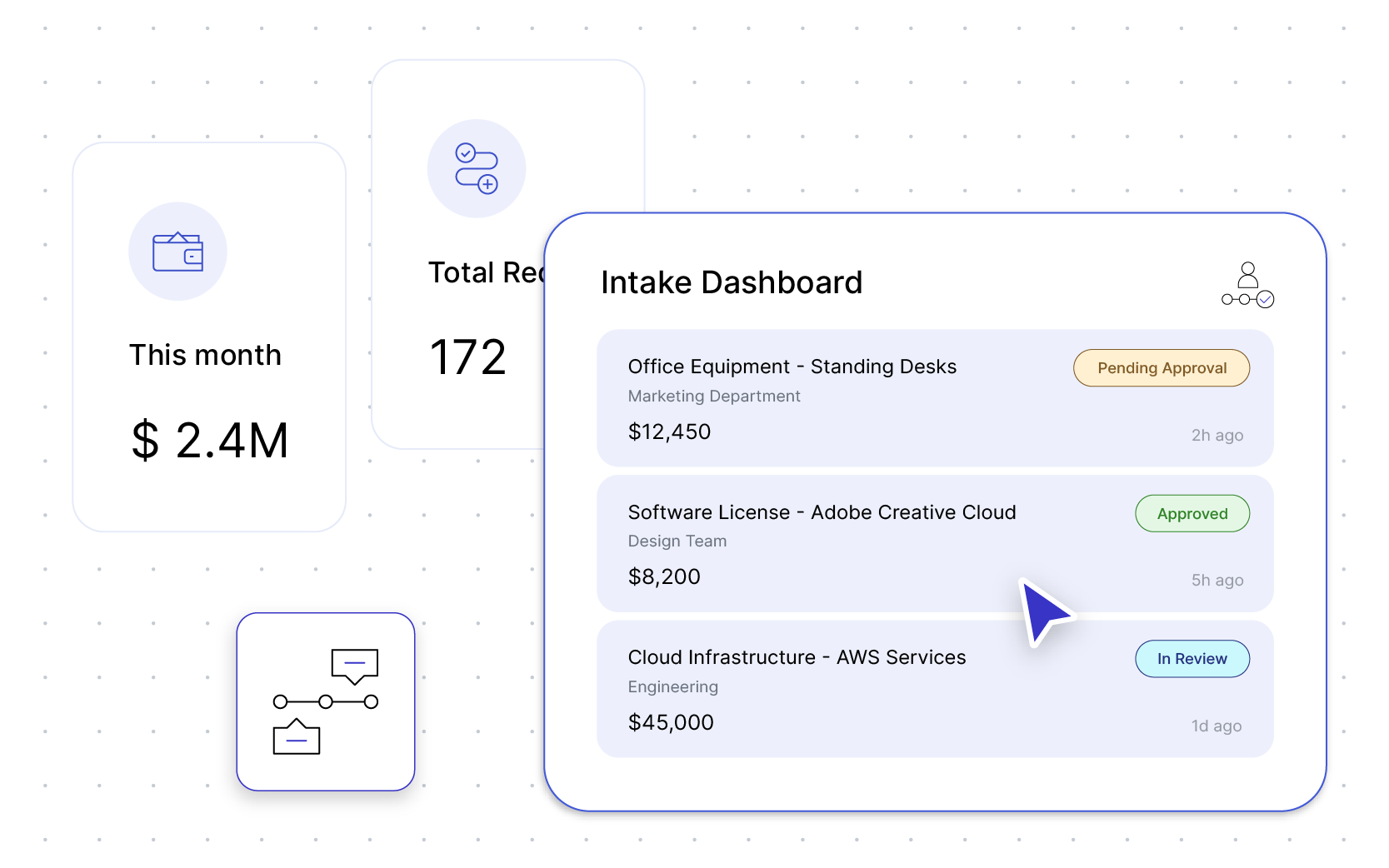
 VendrNova
Intake workspace
Updated just now · All entities
New requests
172
+8.3%
Needs context
18
Review
Approved
108
This month
Avg. cycle
2.4d
Trending down
Workflow before and after VendrNova
The value of a module is clearest when buyers can see how the work changes before, during, and after the handoff.
Before VendrNova
When catalog content is incomplete or difficult to trust, users move around it and procurement loses leverage.
Users search old files, supplier sites, email threads, or local knowledge for current items and prices.
Procurement updates content without a clear ownership rhythm, change history, or entity view.
Poor descriptions, outdated prices, and missing guidance create rework, exceptions, and off-catalog spend.
With VendrNova
Users can find a trusted option while procurement keeps the content, policy, and supplier context that makes it safe to use.
Organize products and services with clear descriptions, suppliers, pricing, and buying guidance.
Make ownership, updates, entity applicability, and exceptions visible to the teams maintaining the catalog.
Pass the approved item or service into requisition, order, receipt, invoice, and spend records.
Roles involved
Enterprise adoption improves when each stakeholder can see the part of the workflow they own and the context they need from the role before them.
Explains the need, outcome, timing, and business context before a buying path is chosen.
Triage demand, set the right route, and keep category and supplier context connected.
Reviews policy, budget, entity, and risk with enough detail to make a timely decision.
Maintains identity, master data, integration responsibilities, and the system-of-record boundary.
Integration, ERP, governance, and security
A commercial page should help the buying group understand what connects, what remains authoritative, and which controls need to be reviewed before rollout.
Catalog content should align with supplier, item, service, price, unit-of-measure, entity, tax, and account data in the ERP and finance environment. Decide which system owns the record and how changes are approved and synchronized.
Catalog governance is a data and buying control. Review who can publish, change, approve, retire, or override content, and make the relationship between the catalog choice and the final transaction auditable.
Implementation approach
Start with a category where users need help choosing and the current catalog creates exceptions. Clean a focused set of content, establish ownership, test the user journey, and expand with a repeatable maintenance rhythm.
Implementation principle
Start with the request paths people actually use.
Scope the workflow around the decision, data, owners, and handoffs that need to work after launch—not only the screens that need to be configured.
Identify request types, owners, decision points, and the off-channel work to replace.
Translate policy, category, entity, threshold, and risk into a guided path.
Test with representative requesters and approvers, then tune forms, rules, and handoffs.
Add adjacent buying paths once adoption, ownership, and downstream status are clear.
Customer evidence
Use the customer voice below as a starting point, then test the same workflow against your own systems, roles, controls, and priorities.
“VendrNova’s MIS dashboard gives us control and capability. We automated 80% of purchase orders and 95% of GRs, cut approval times from days to hours, and gained real-time visibility across our vendor network.”

Abhay Kulkarni
AVP PSM · TKIL Industries Pvt Ltd. (formerly thyssenkrupp Industries India Pvt Ltd.)
Relevant FAQs
Clear answers help procurement, finance, IT, security, and business stakeholders enter the same conversation.
Procurement catalog management keeps approved products and services, supplier content, pricing, buying guidance, and applicability organized so users can make compliant choices during the request process.
The catalog can provide the buying experience and pass selected item, supplier, account, or pricing context into the ERP or purchasing process. The integration design should define authoritative data and update responsibilities.
Ownership commonly spans procurement or category teams, suppliers, finance, and IT. The important design decision is to make content ownership, approval, updates, and retirement explicit.
Prioritize high-volume categories, frequent off-catalog requests, supplier content with clear business value, and areas where better selection can reduce rework or policy exceptions.
Next step for Catalog Management
Bring one category or catalog problem to VendrNova and define the content, ownership, and handoff needed to improve adoption without losing control.