Accounts payable
Keeps invoice intake, validation, matching, exception routing, and payment readiness moving.

Invoice, Spend & Payments
Connect request, approval, purchase order, invoice, and budget context so teams can act earlier.
Who this is for
Budget Control is for enterprises where budgets, requests, orders, invoices, and payment decisions are managed by different teams or systems and the commitment appears too late.
Buyer lens
The buying question is not only whether this capability works. It is whether the right people can use it, govern it, and carry the context into the next step.
Why teams use it
A focused capability should remove uncertainty from the people doing the work while keeping the business rules and accountability intact.
 VendrNova
Spend intelligence
Updated just now · All entities
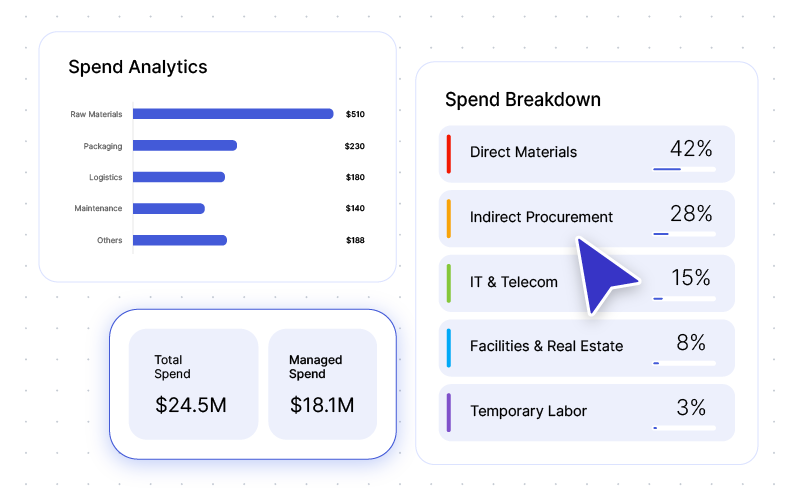
Total spend
$24.5M
Current view
Managed spend
$18.1M
74% in view
Categories
42
Analyzed
Opportunities
16
Prioritized
Managed spend
$18.1M
74% of current view
Prioritized
16
opportunities ready
Workflow before and after VendrNova
The value of a module is clearest when buyers can see how the work changes before, during, and after the handoff.
Before VendrNova
The organization can see an invoice or order, but not always the full commitment, owner, or remaining room before approval.
Requests and expected commitments are not consistently connected to budget owner, account, project, or entity.
Reviewers see a transaction without current commitments, related orders, or downstream risk.
Finance discovers pressure through exceptions, invoices, or reconciliation instead of the request path.
With VendrNova
Requesters, approvers, procurement, and finance can see the decision, available context, owner, and exception path before value is locked in.
Connect request, contract, order, receipt, invoice, and budget context at the decision point.
Make budget ownership, threshold, entity, policy, and exception approval visible.
Carry approved and open commitments into finance review and planning context.
Roles involved
Enterprise adoption improves when each stakeholder can see the part of the workflow they own and the context they need from the role before them.
Keeps invoice intake, validation, matching, exception routing, and payment readiness moving.
Owns the purchase context, supplier relationship, order accuracy, and commercial resolution.
Confirms what was requested, delivered, accepted, or disputed so the record can be resolved.
Maintains financial authority, posting, payment, master data, and reconciliation responsibilities.
Integration, ERP, governance, and security
A commercial page should help the buying group understand what connects, what remains authoritative, and which controls need to be reviewed before rollout.
Budget control depends on consistent exchange of account, cost center, project, entity, budget, commitment, requisition, purchase order, invoice, and payment data with the ERP and finance environment.
Budget control should make authority, thresholds, delegation, exception reasons, and evidence clear without duplicating financial authority. Protect financial and supplier data and preserve the approval history.
Implementation approach
Start with a budget area where unplanned commitments or approval surprises are visible. Map the decision points and ERP boundaries, pilot with budget owners, and refine the experience around real exceptions.
Implementation principle
Start where exceptions consume the most time.
Scope the workflow around the decision, data, owners, and handoffs that need to work after launch—not only the screens that need to be configured.
Map capture, validation, receipt, service entry, matching, approval, posting, and payment states.
Agree reason codes, ownership, evidence, escalation, and the handoff back to procurement or the requester.
Test representative two-way, three-way, and service-based scenarios with finance and operations.
Use exception learning to improve requisitions, orders, receipts, suppliers, and budget controls.
Customer evidence
Use the customer voice below as a starting point, then test the same workflow against your own systems, roles, controls, and priorities.
“VendrNova’s deep integration with our SAP environment enables seamless data exchange, eliminates manual dependencies, and delivers accurate, real-time insights to support procurement decisions.”

Vijay Khanore
IT / SAP-MM Lead · Welspun Corp
Relevant FAQs
Clear answers help procurement, finance, IT, security, and business stakeholders enter the same conversation.
Procurement budget control connects demand, approval, purchase orders, invoices, commitments, and budget ownership so financial context is visible before a decision becomes a surprise.
It should not have to. VendrNova can provide procurement workflow and commitment context around the financial systems the enterprise already trusts, with authority and synchronization defined in the implementation.
Budget context is most useful before approval and commitment, then again as orders, receipts, invoices, and exceptions change the expected financial outcome.
Show the reason, amount, owner, authority, evidence, timing, and follow-up for the exception, then keep the outcome connected to the underlying request or transaction.
Next step for Budget Control
Bring a budget or approval gap to VendrNova and map the request, commitment, ERP context, authority, and exception path your teams need.