Accounts payable
Keeps invoice intake, validation, matching, exception routing, and payment readiness moving.

Invoice, Spend & Payments
Turn procurement activity into a usable spend picture that helps leaders prioritize action.
Who this is for
Spend Analysis is for enterprises where spend data is fragmented across suppliers, categories, entities, accounts, invoices, and purchasing channels, making opportunity difficult to prioritize.
Buyer lens
The buying question is not only whether this capability works. It is whether the right people can use it, govern it, and carry the context into the next step.
Why teams use it
A focused capability should remove uncertainty from the people doing the work while keeping the business rules and accountability intact.
 VendrNova
Spend intelligence
Updated just now · All entities
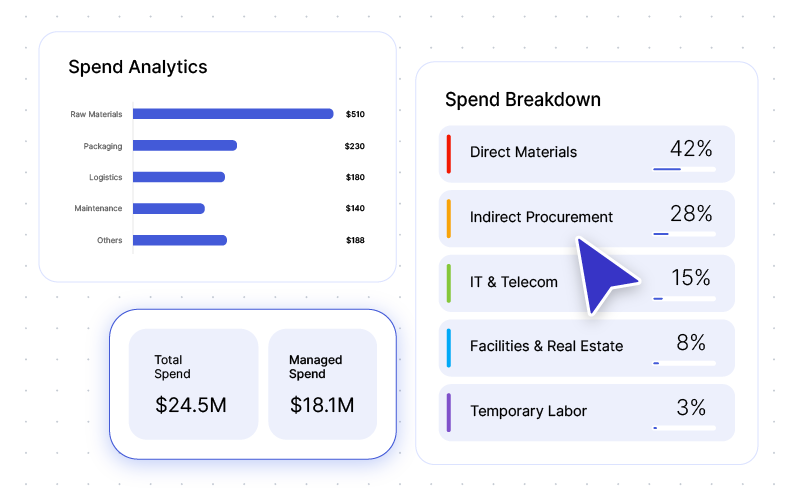
Total spend
$24.5M
Current view
Managed spend
$18.1M
74% in view
Categories
42
Analyzed
Opportunities
16
Prioritized
Managed spend
$18.1M
74% of current view
Prioritized
16
opportunities ready
Workflow before and after VendrNova
The value of a module is clearest when buyers can see how the work changes before, during, and after the handoff.
Before VendrNova
The organization has spend files and dashboards, but definitions and context differ from one review to the next.
Invoices, POs, card or expense activity, supplier records, and finance dimensions are analyzed separately.
Teams spend time cleaning, mapping, and reconciling instead of deciding where action matters.
Leaders see totals but not the supplier, contract, process, or owner behind the potential action.
With VendrNova
The analysis connects categories, suppliers, entities, commitments, and workflow context to the decisions procurement can make next.
Align spend sources, definitions, supplier identity, category structure, entity, and time period.
Separate leakage, consolidation, sourcing, contract, budget, and process opportunities.
Give the category, supplier, finance, or business owner enough context to move from insight to work.
Roles involved
Enterprise adoption improves when each stakeholder can see the part of the workflow they own and the context they need from the role before them.
Keeps invoice intake, validation, matching, exception routing, and payment readiness moving.
Owns the purchase context, supplier relationship, order accuracy, and commercial resolution.
Confirms what was requested, delivered, accepted, or disputed so the record can be resolved.
Maintains financial authority, posting, payment, master data, and reconciliation responsibilities.
Integration, ERP, governance, and security
A commercial page should help the buying group understand what connects, what remains authoritative, and which controls need to be reviewed before rollout.
Spend analysis should connect ERP, accounts payable, purchase orders, supplier master, contracts, budgets, and other authorized sources with clear data lineage and definitions. The output should link back to records, not become an unexplained total.
Spend data can include sensitive supplier, employee, financial, and commercial information. Govern access, definitions, data quality, refresh, source ownership, and the evidence behind an opportunity or exception.
Implementation approach
Start with a decision such as category prioritization, supplier consolidation, leakage, or contract coverage. Align definitions and sources, build the first view, and put it into a recurring review with an accountable owner.
Implementation principle
Start where exceptions consume the most time.
Scope the workflow around the decision, data, owners, and handoffs that need to work after launch—not only the screens that need to be configured.
Map capture, validation, receipt, service entry, matching, approval, posting, and payment states.
Agree reason codes, ownership, evidence, escalation, and the handoff back to procurement or the requester.
Test representative two-way, three-way, and service-based scenarios with finance and operations.
Use exception learning to improve requisitions, orders, receipts, suppliers, and budget controls.
Customer evidence
Use the customer voice below as a starting point, then test the same workflow against your own systems, roles, controls, and priorities.
“VendrNova’s deep integration with our SAP environment enables seamless data exchange, eliminates manual dependencies, and delivers accurate, real-time insights to support procurement decisions.”

Vijay Khanore
IT / SAP-MM Lead · Welspun Corp
Relevant FAQs
Clear answers help procurement, finance, IT, security, and business stakeholders enter the same conversation.
Procurement spend analysis organizes purchasing, invoice, supplier, category, entity, and commitment data so leaders can understand where money is moving and prioritize action.
ERP and finance data can provide authoritative transactions, accounts, entities, suppliers, and commitments, while the analysis layer creates a more useful view for category and procurement decisions.
Spend analysis often focuses on understanding and classifying the current spend picture. Spend analytics can extend that view into patterns, signals, prioritization, and action over time. The terms can overlap by organization.
Look for faster category prioritization, cleaner supplier and category definitions, better visibility into managed or unmanaged spend, stronger sourcing decisions, and actions linked to the analysis.
Next step for Spend Analysis
Bring the spend question leadership keeps asking to VendrNova and connect the data, definitions, evidence, and owner behind the next action.