Category manager
Sets the commercial question, requirements, market strategy, and value hypotheses for the event.

Strategic Sourcing Management
Run live competitive events with the rules, visibility, and supplier participation your team can stand behind.
Who this is for
eAuctions are for sourcing leaders that need clear event rules, supplier participation, bid visibility, and a defensible transition from live competition to award.
Buyer lens
The buying question is not only whether this capability works. It is whether the right people can use it, govern it, and carry the context into the next step.
Why teams use it
A focused capability should remove uncertainty from the people doing the work while keeping the business rules and accountability intact.
 VendrNova
Sourcing event
Updated just now · All entities
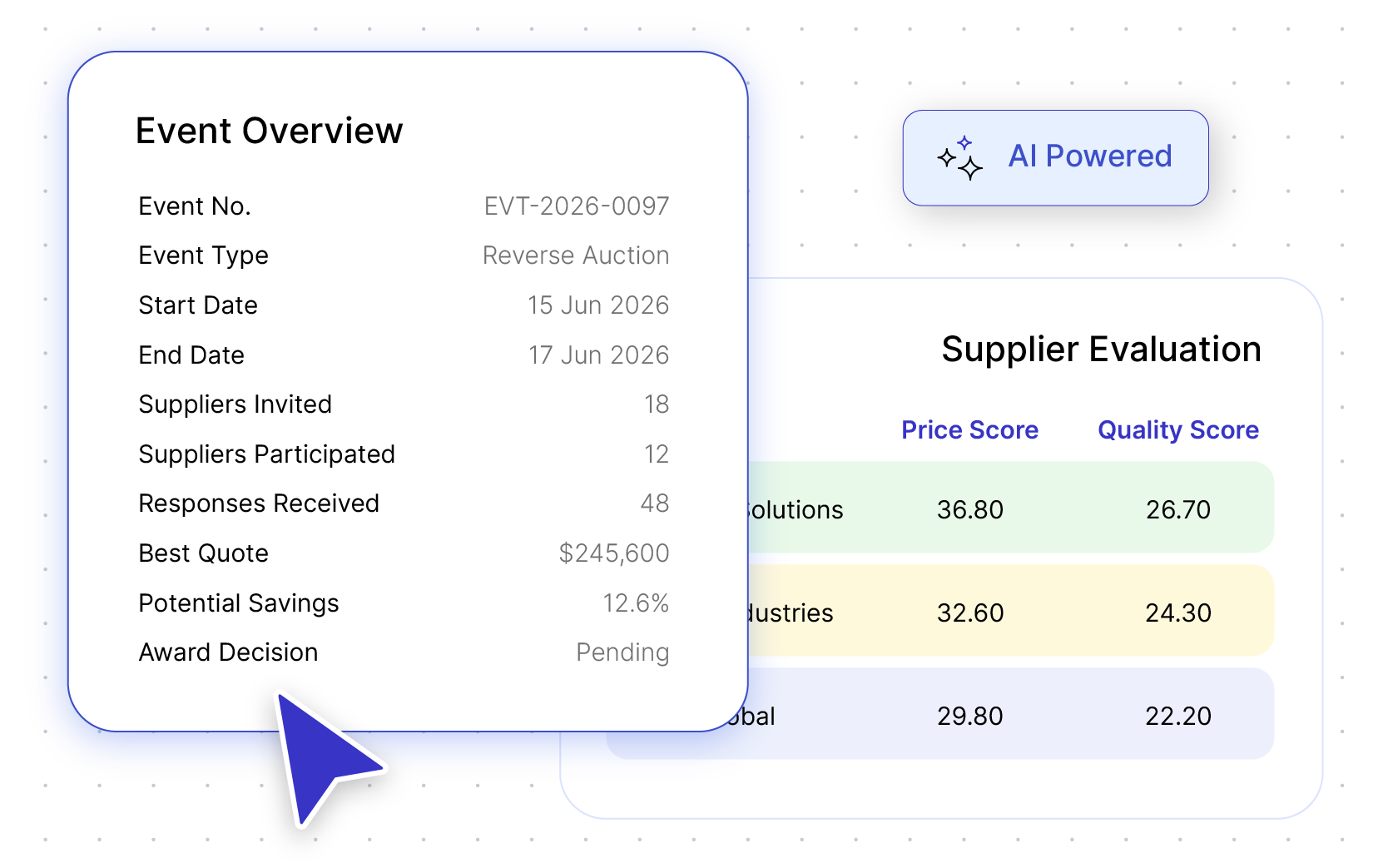
Suppliers invited
18
12 active
Responses
48
Received
Best quote
$245.6K
Current
Potential savings
12.6%
In view
Event
EVT-2026-0097
Live
Responses
48
Received
Savings
12.6%
In view
Workflow before and after VendrNova
The value of a module is clearest when buyers can see how the work changes before, during, and after the handoff.
Before VendrNova
Live bids can move quickly while the surrounding rules, supplier support, and award context remain manual.
Suppliers and internal participants rely on email or documents to understand the event mechanics.
The team watches activity but lacks a clear shared view of participation, sequence, and result.
The auction result is separated from technical fit, commercial context, approvals, and contract next steps.
With VendrNova
The auction is one part of a clear decision path, not a standalone moment disconnected from the category strategy.
Define item structure, qualification, timing, access, participation, and event conditions.
Keep supplier participation and bid movement visible to the people responsible for the event.
Combine auction outcome with technical, risk, approval, and award context before moving forward.
Roles involved
Enterprise adoption improves when each stakeholder can see the part of the workflow they own and the context they need from the role before them.
Sets the commercial question, requirements, market strategy, and value hypotheses for the event.
Scores fit, capability, risk, and practical requirements without losing the commercial thread.
Receives a clear event structure, responds with the right evidence, and sees what is required next.
Reviews the recommendation, negotiation boundaries, award rationale, and path into contract.
Integration, ERP, governance, and security
A commercial page should help the buying group understand what connects, what remains authoritative, and which controls need to be reviewed before rollout.
Auction setup and outcome should use consistent supplier, item, category, entity, currency, and commercial data, then carry the awarded result into contracts, catalogs, purchase orders, and spend records.
Auction governance requires eligibility, event rules, participant access, bid confidentiality, exception handling, approval, and an auditable result. Security review should cover supplier and commercial information.
Implementation approach
Choose a category where the specification and supplier market support transparent competition. Align the rules and award method first, then run a pilot with supplier enablement and post-event review.
Implementation principle
Build from one repeatable sourcing motion.
Scope the workflow around the decision, data, owners, and handoffs that need to work after launch—not only the screens that need to be configured.
Select a category and event pattern where manual coordination or decision risk is visible.
Define requirements, roles, scoring, approvals, supplier communication, and award evidence.
Use a live event to test participation, comparison, collaboration, and handoff quality.
Turn the learning into reusable templates and connect the awarded outcome downstream.
Customer evidence
Use the customer voice below as a starting point, then test the same workflow against your own systems, roles, controls, and priorities.
“VendrNova brought sourcing, approvals, and purchasing into a more structured flow. Follow-ups are down, approvals are easier to track, and procurement cycles move faster.”

Samik Das
Sr. Director, Global Procurement APAC · Signode India
Relevant FAQs
Clear answers help procurement, finance, IT, security, and business stakeholders enter the same conversation.
An eAuction can fit categories with clear specifications, a meaningful competitive supplier field, and a buying objective that benefits from transparent price competition. It should be part of a broader sourcing decision.
The event can use supplier, item, category, entity, and commercial context from connected systems, then pass the result into award, contract, catalog, or purchasing workflows.
Important controls include supplier eligibility, event rules, participant access, timing, bid handling, exceptions, approval, confidentiality, and a complete result record.
Not necessarily. The auction result should be considered alongside technical fit, supplier readiness, risk, terms, delivery, and the decision criteria agreed for the category.
Next step for eAuctions
Bring a category where live competition could help and define the rules, supplier experience, evidence, and award handoff with VendrNova.