Category manager
Sets the commercial question, requirements, market strategy, and value hypotheses for the event.

Strategic Sourcing Management
Bring offers, counteroffers, tradeoffs, and decisions into one view so teams can negotiate with context.
Who this is for
Negotiation Management is for complex commercial conversations where offers, counteroffers, tradeoffs, stakeholders, and approvals shape the final supplier decision.
Buyer lens
The buying question is not only whether this capability works. It is whether the right people can use it, govern it, and carry the context into the next step.
Why teams use it
A focused capability should remove uncertainty from the people doing the work while keeping the business rules and accountability intact.
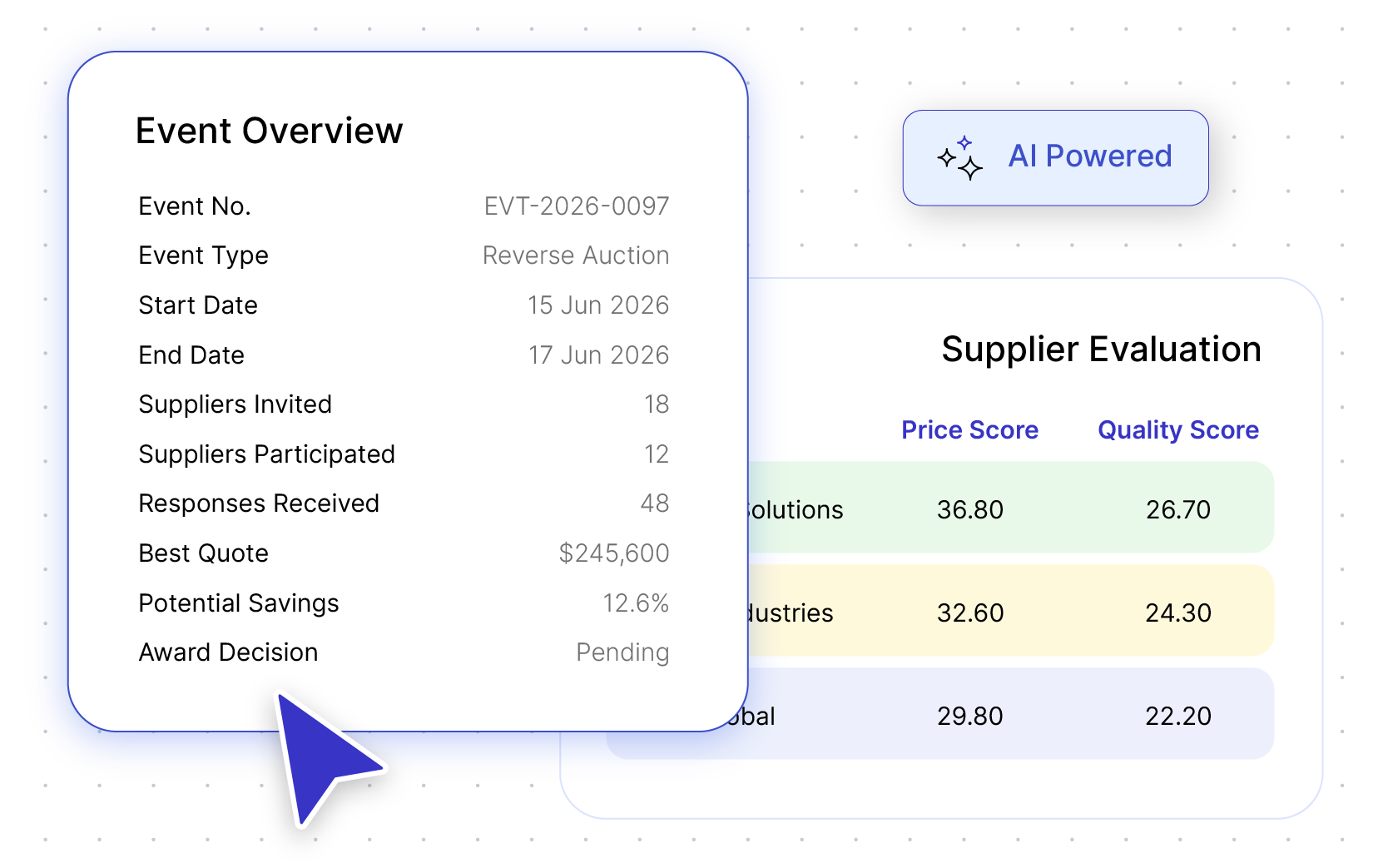
 VendrNova
Sourcing event
Updated just now · All entities
Suppliers invited
18
12 active
Responses
48
Received
Best quote
$245.6K
Current
Potential savings
12.6%
In view
Event
EVT-2026-0097
Live
Responses
48
Received
Savings
12.6%
In view
Workflow before and after VendrNova
The value of a module is clearest when buyers can see how the work changes before, during, and after the handoff.
Before VendrNova
Commercial progress is real, but the record is spread across inboxes, calls, files, and personal notes.
Supplier offers and counteroffers use different assumptions, versions, and units of measure.
Stakeholders know what changed but not always why the team accepted the movement.
Contract and operations teams receive a final number without the constraints and commitments behind it.
With VendrNova
The team can see the movement, owner, rationale, approval boundary, and terms that need to carry into execution.
Keep offers, counteroffers, assumptions, variables, and supplier context in one negotiation view.
Give stakeholders the evidence and ownership needed to review a movement or exception.
Pass approved terms and rationale into the contract, supplier, catalog, and buying path.
Roles involved
Enterprise adoption improves when each stakeholder can see the part of the workflow they own and the context they need from the role before them.
Sets the commercial question, requirements, market strategy, and value hypotheses for the event.
Scores fit, capability, risk, and practical requirements without losing the commercial thread.
Receives a clear event structure, responds with the right evidence, and sees what is required next.
Reviews the recommendation, negotiation boundaries, award rationale, and path into contract.
Integration, ERP, governance, and security
A commercial page should help the buying group understand what connects, what remains authoritative, and which controls need to be reviewed before rollout.
Negotiation management should connect event, supplier, category, item, service, contract, and award context while avoiding duplicate financial records. The final agreed terms need a clear handoff into the systems that govern buying and payment.
Negotiation records can contain highly sensitive commercial information. Control access, preserve versions and approvals, separate negotiation authority, and define how evidence is retained and exposed to downstream teams.
Implementation approach
Start with a negotiation type where version history and stakeholder alignment matter most. Define the fields, approval points, and handoff requirements, then use one live negotiation to validate the flow.
Implementation principle
Build from one repeatable sourcing motion.
Scope the workflow around the decision, data, owners, and handoffs that need to work after launch—not only the screens that need to be configured.
Select a category and event pattern where manual coordination or decision risk is visible.
Define requirements, roles, scoring, approvals, supplier communication, and award evidence.
Use a live event to test participation, comparison, collaboration, and handoff quality.
Turn the learning into reusable templates and connect the awarded outcome downstream.
Customer evidence
Use the customer voice below as a starting point, then test the same workflow against your own systems, roles, controls, and priorities.
“VendrNova brought sourcing, approvals, and purchasing into a more structured flow. Follow-ups are down, approvals are easier to track, and procurement cycles move faster.”

Samik Das
Sr. Director, Global Procurement APAC · Signode India
Relevant FAQs
Clear answers help procurement, finance, IT, security, and business stakeholders enter the same conversation.
Procurement negotiation management keeps supplier offers, counteroffers, tradeoffs, approvals, and agreed terms connected so the commercial decision can be reviewed and executed.
It sits between supplier evaluation and the final agreement, preserving the reasoning and terms that should inform contract drafting, supplier setup, catalogs, orders, and future reviews.
Access should reflect negotiation authority, commercial sensitivity, and the role each stakeholder plays. Procurement, legal, finance, business, and approvers may need different views.
Carry the agreed commercial terms, obligations, exceptions, approvals, assumptions, and ownership needed to make the contract and downstream buying reflect the decision.
Next step for Negotiation Management
Bring a commercial workflow where context disappears between negotiation and contract, and define the evidence and handoff VendrNova should preserve.