Supplier owner and procurement
Owns the relationship, business need, commercial context, and next decision across the lifecycle.

Supplier Management
Give suppliers and internal teams a structured path to collect the information, approvals, and documentation needed to begin.
Who this is for
Supplier Onboarding is for organizations where new suppliers are delayed by incomplete information, unclear reviewers, duplicate records, or documents that cannot be trusted later.
Buyer lens
The buying question is not only whether this capability works. It is whether the right people can use it, govern it, and carry the context into the next step.
Why teams use it
A focused capability should remove uncertainty from the people doing the work while keeping the business rules and accountability intact.
 VendrNova
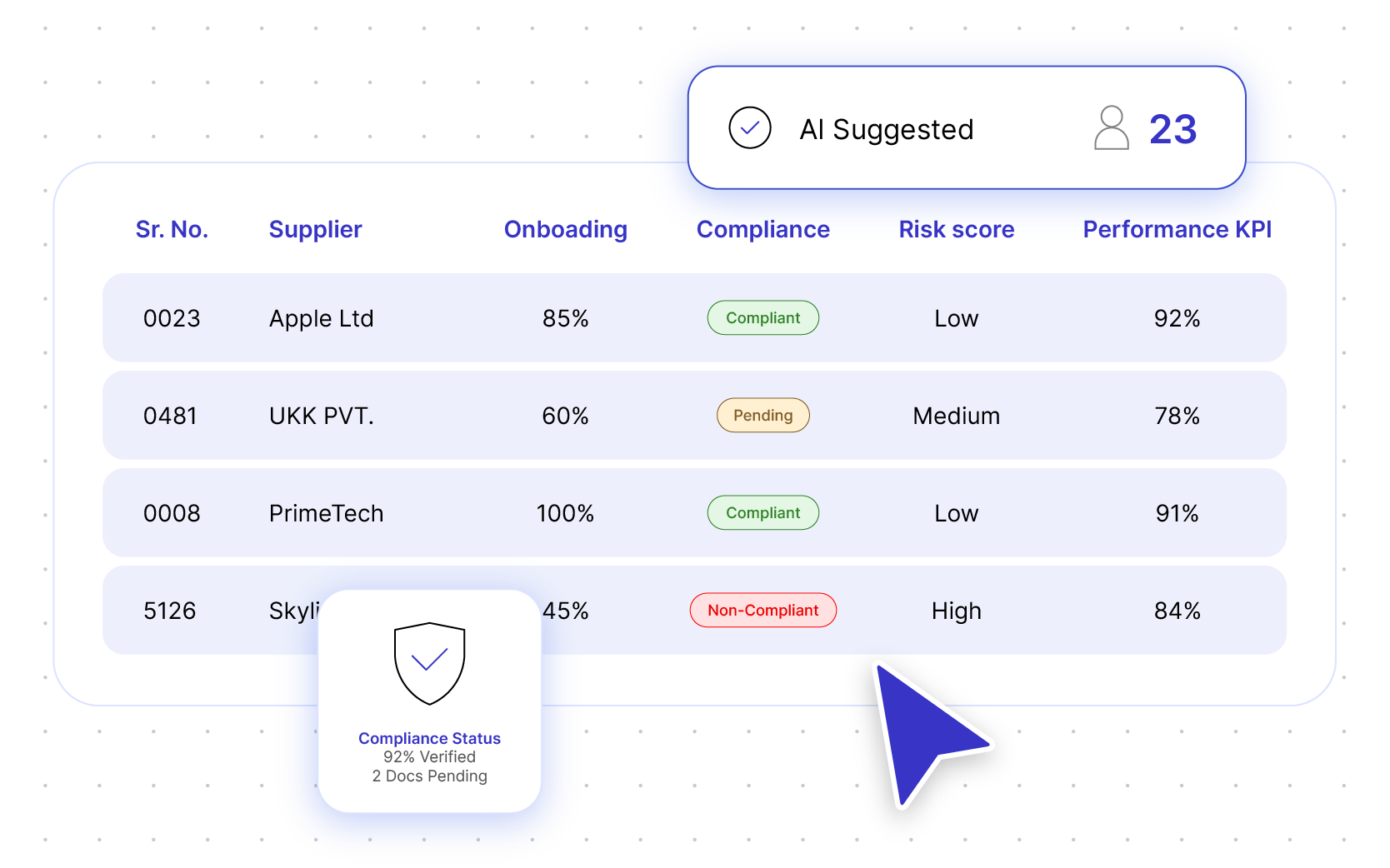
Supplier health
Updated just now · All entities
Active suppliers
2,483
+4.1%
Ready to transact
92%
Verified
Reviews due
23
This month
High risk
8
Needs owner
92%
Verified
92%
On track
78%
Review
8
Assigned
Workflow before and after VendrNova
The value of a module is clearest when buyers can see how the work changes before, during, and after the handoff.
Before VendrNova
The supplier, procurement team, and reviewers each hold part of the information needed to begin work.
Supplier details and documents arrive through email, attachments, or local forms with no shared checklist.
Internal teams wait on one another because the next approval and missing evidence are not visible.
Approved information is re-entered into purchasing, finance, or supplier systems after the decision.
With VendrNova
Suppliers know what to provide, reviewers know what to assess, and the approved record can move into execution.
Use a structured supplier path for required information, documents, declarations, and contacts.
Route the record to finance, risk, legal, quality, and business owners with clear status and ownership.
Make approval, conditions, expiry, and downstream supplier setup visible.
Roles involved
Enterprise adoption improves when each stakeholder can see the part of the workflow they own and the context they need from the role before them.
Owns the relationship, business need, commercial context, and next decision across the lifecycle.
Collects information, qualification evidence, risk signals, and remediation actions.
Connects supplier readiness and performance to operational requirements and outcomes.
Protects the quality of supplier records used for contracting, purchasing, invoicing, and payment.
Integration, ERP, governance, and security
A commercial page should help the buying group understand what connects, what remains authoritative, and which controls need to be reviewed before rollout.
Onboarding should align supplier identity, tax, banking, entity, category, payment, and compliance data with ERP and finance master-data responsibilities. Define when a supplier becomes eligible for sourcing, contracting, ordering, and payment.
Supplier onboarding involves sensitive financial, personal, and compliance information. Use permissioned access, review separation, document status, expiry, audit history, and a clear process for exceptions and changes.
Implementation approach
Start with one supplier type and a clear ready-to-work definition. Map the evidence, reviewers, approvals, ERP setup, and supplier experience, then extend to more categories and entities.
Implementation principle
Begin with the lifecycle moment creating the most risk.
Scope the workflow around the decision, data, owners, and handoffs that need to work after launch—not only the screens that need to be configured.
Agree what a supplier must provide, who reviews it, and what ready-to-work means.
Align supplier data, documents, statuses, and owners with the systems and workflows that use them.
Test onboarding, review, change, or performance with a representative supplier group.
Extend from readiness into performance, risk, renewal, and supplier collaboration.
Customer evidence
Use the customer voice below as a starting point, then test the same workflow against your own systems, roles, controls, and priorities.
“VendrNova helped us consolidate supplier management, improve compliance visibility, and keep onboarding, approvals, and the audit trail in one place.”

G. Saraswat
DGM (MM) Procurement · FSNL Pvt. Ltd
Relevant FAQs
Clear answers help procurement, finance, IT, security, and business stakeholders enter the same conversation.
Supplier onboarding software gives suppliers and internal teams a structured path to collect information, documents, approvals, and status before the supplier begins approved work.
Requirements vary by organization and supplier type, but may include legal identity, tax, banking, contacts, capabilities, compliance documents, risk evidence, and approval context.
The approved onboarding record can support supplier master-data creation or update, while ERP and finance systems remain authoritative for the transactional information they own.
Make requirements clear, collect complete information once, route the right reviewers, show missing evidence, and keep the final approval and conditions traceable.
Next step for Supplier Onboarding
Bring one supplier onboarding path to VendrNova and design the evidence, review ownership, approval, and ERP handoff around the decision to transact.